
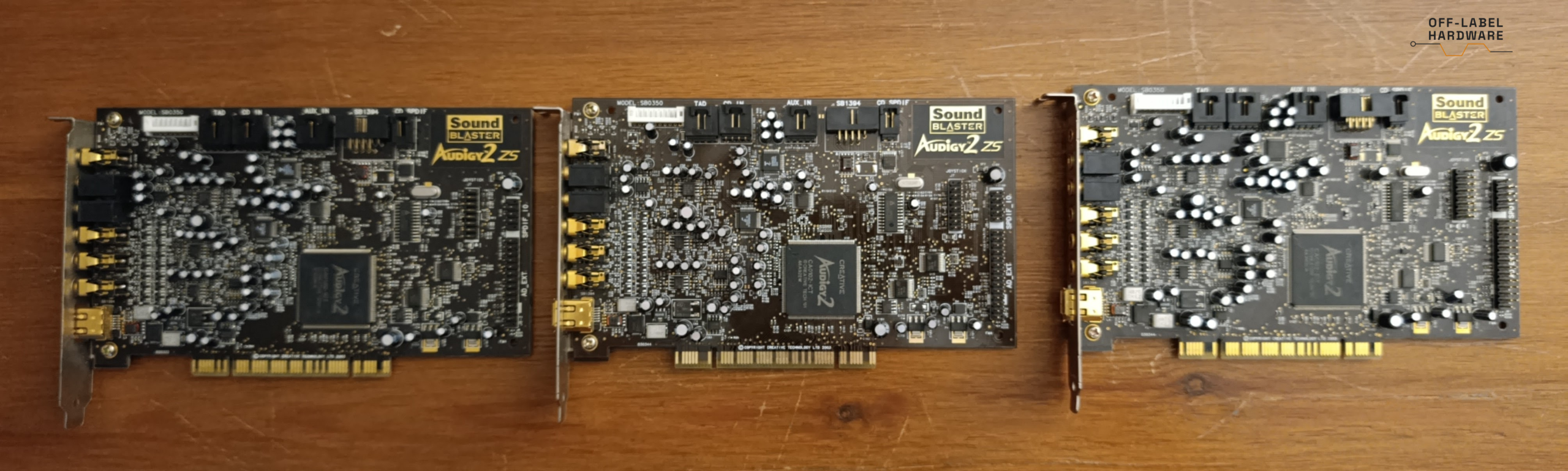
Part 1 — Turning Sound Cards Into a Switch
I have accumulated quite a few old sound cards over the years. Most of them are still perfectly usable, but their original purpose has become increasingly difficult to justify.
Modern motherboards already provide decent audio, and external USB interfaces have become inexpensive and extremely capable. For most systems, there is little reason to install an old sound card.
But one particular card has an interesting capability that makes it useful for a very different purpose: the Creative Audigy 2 ZS.
I wanted to solve a particular problem in my audio system: 5.1-channel analog switching.
My audio system uses six analog channels — Front Left/Right, Rear Left/Right, Center and Subwoofer — and I wanted to be able to switch between multiple 5.1 sources without converting the signal to digital and back again.
The obvious solution would be a dedicated multi-channel analog switch.
But where would be the fun in that?
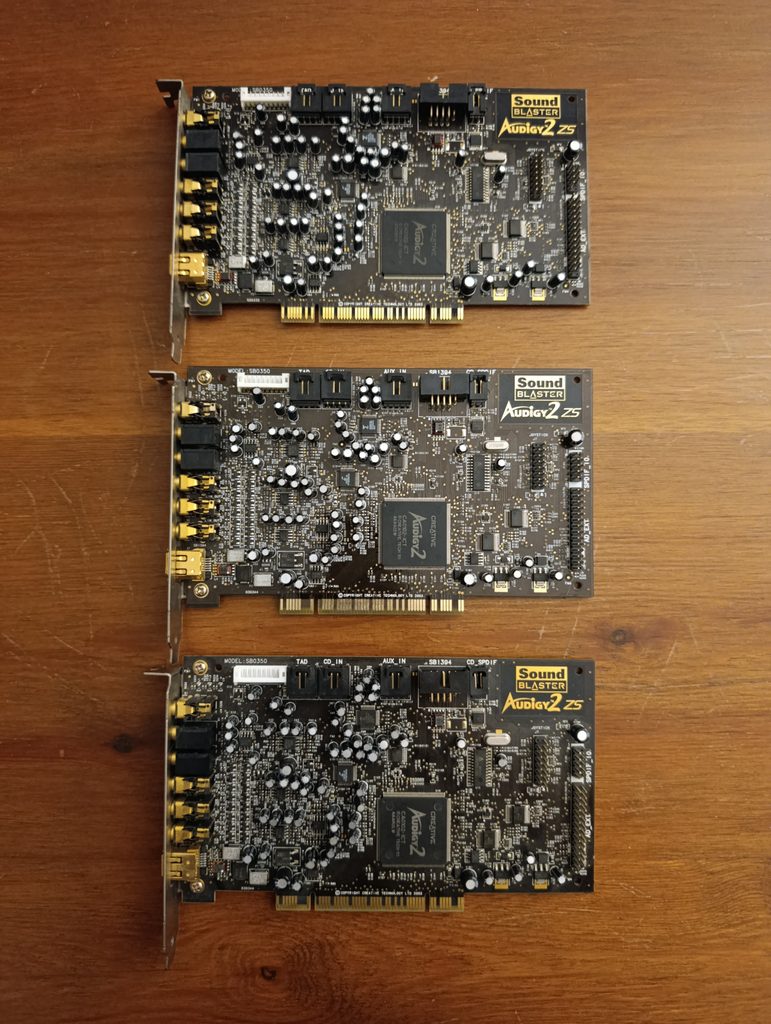
I had three Creative Audigy 2 ZS sound cards.
And that raised an unusual possibility.
Three Audigy 2 ZS With Another Job
The Audigy 2 ZS is fundamentally a PC sound card. It has analog inputs, multi-channel analog outputs and circuitry designed to handle surround audio.
I started wondering whether its particular analog connectivity could be repurposed as something completely different:
an analog audio switch.
Instead of asking each Audigy 2 ZS to function as a conventional sound card, the idea was to use the cards’ analog connections to route individual channels.
Three Audigy 2 ZS cards would provide enough analog connectivity to construct the switching arrangement I needed.
The important part was that the actual signal path would remain analog.
There would be no requirement to capture the audio into the computer, process it digitally and then convert it back to analog.
The PC would essentially become a control mechanism for a collection of old audio circuits.
Why Not Just Use a Digital Solution?
There are plenty of modern ways to solve this problem.
A digital audio processor could accept multiple sources, switch between them and provide the required outputs. An AVR could do much of the same thing. A dedicated analog switching matrix would also be a perfectly sensible solution.
But this experiment isn’t about finding the easiest way to accomplish something.
It is about finding another use for hardware that already exists.
The Audigy 2 ZS cards are inexpensive, obsolete by today’s standards and surprisingly well equipped for their original era. Rather than leaving them in a box, I wanted to see whether their analog circuitry could be turned into a useful piece of infrastructure.
There is also something satisfying about doing a 5.1-channel switch entirely in the analog domain with hardware that was originally designed to be a PC sound card.
The Challenge
The difficult part isn’t switching one stereo signal.
Switching stereo is easy.
The challenge is doing it with six channels simultaneously while keeping the channels correctly matched and avoiding unwanted interaction between sources.
Every source has:
- Front Left
- Front Right
- Rear Left
- Rear Right
- Center
- LFE
A proper switch therefore has to treat the six channels as a single 5.1 system.
The three Audigy 2 ZS cards provide the hardware needed to build this arrangement, while also making the project considerably more interesting than simply wiring a few mechanical switches together.
The goal isn’t to make the Audigy 2 ZS cards process the audio.
Their new job is much simpler:
move the right analog signal to the right place.
An Unusual Second Life
There is something particularly appropriate about using an old sound card this way.
The Audigy 2 ZS was designed at a time when a PC’s audio capabilities were still a major part of its identity. Multi-channel gaming, DVD audio and surround sound were important selling points.
Years later, the same hardware can potentially become something much simpler and more specialized.
Not a conventional sound card.
Not a gaming audio processor.
Not an effects processor.
An analog switching component.
The experiment is therefore less about whether an Audigy 2 ZS is still a good sound card.
It is about whether the analog hardware inside an obsolete Audigy 2 ZS can be useful after its original purpose has disappeared.
And that leads to the real question of this project:
Can three Creative Audigy 2 ZS cards become a practical 5.1 analog switch?