
Part 1 — How It All Started
There was no particular reason to keep most of the hardware I had accumulated over the years.
I had a collection of old TV and satellite cards sitting around, many of them designed for technologies that have long since disappeared from everyday use. Analog television is essentially gone, and even DVB-S hardware that once seemed useful has become increasingly difficult to justify in a modern system.
But these cards had something interesting in common.
S-Video.
S-Video was never a high-end video interface. It was better than composite video, but it was still firmly associated with standard-definition equipment. Today, it is almost completely absent from new hardware.
That made me wonder:
Could S-Video still be useful for something it was never designed to do?
One interface isn’t very interesting
A single S-Video connection doesn’t offer much room for experimentation.
The interface was designed to carry standard-definition video, and there is no realistic way to turn one connection into a modern high-resolution video link.
But I didn’t have just one.
I had several.
That changed the question.
What if the image didn’t have to travel through a single S-Video connection?
Instead of trying to make one channel carry more information than it was capable of carrying, perhaps the image could be split across multiple channels.
Imagine taking a high-resolution frame and dividing it into several sections:
┌───────────────────────────────┐
│               │               │
│   Channel 1   │   Channel 2   │
│               │               │
├───────────────┼───────────────┤
│               │               │
│   Channel 3   │               │
│               │               │
└───────────────────────────────┘
Each section would be transmitted independently over its own S-Video connection.
At the other end, three capture devices could theoretically receive the three pieces, synchronize them, and reconstruct the original image.
It was a ridiculous idea.
Which made it interesting.
Finding three outputs
Once I started thinking about the problem this way, the next question was obvious:
How do you get three independent S-Video outputs from one PC?
The straightforward answer is multiple graphics cards.
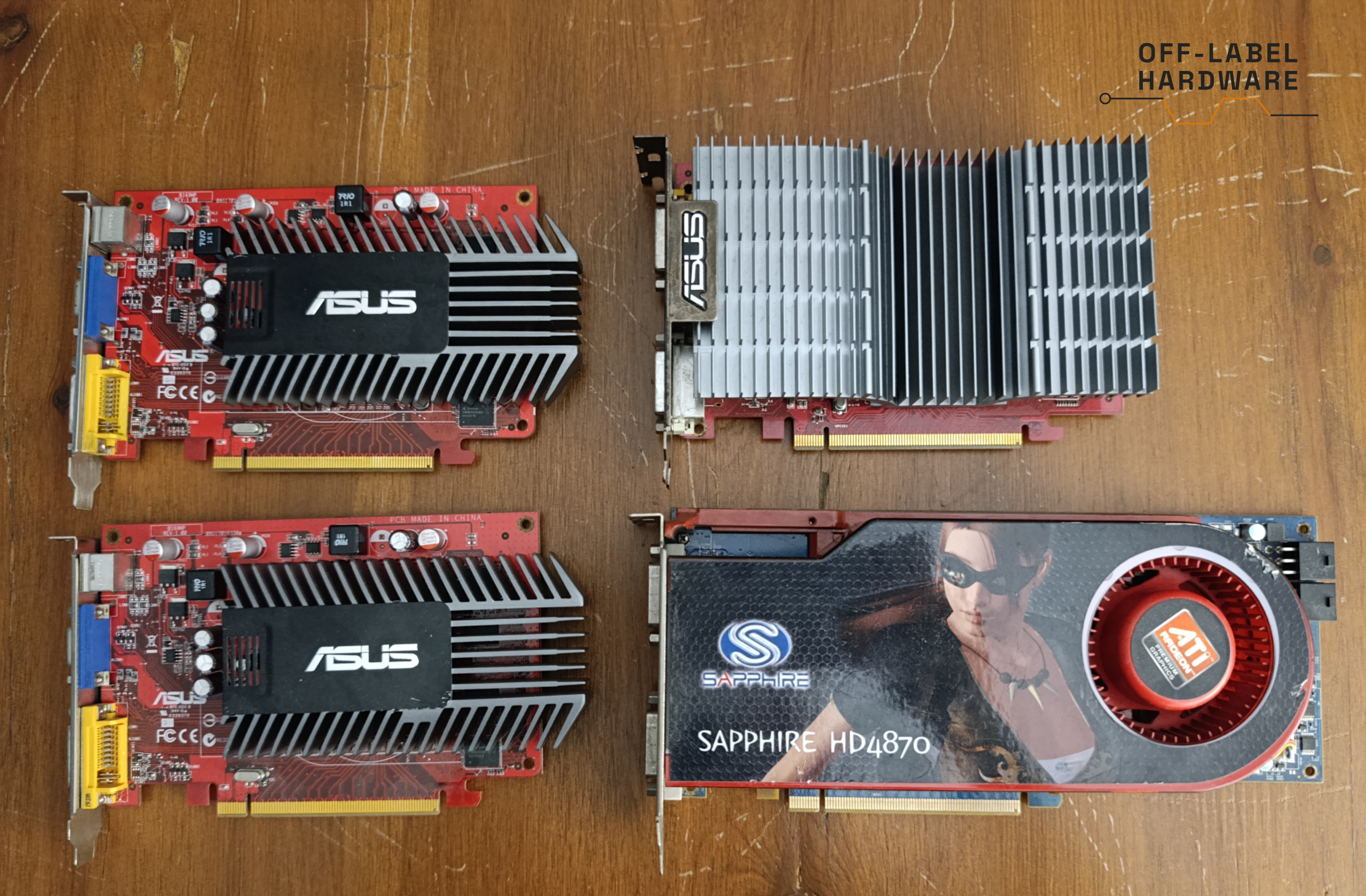
I already had three suitable Radeon cards:
- Radeon HD 3450 ×2
- Radeon HD 3650 ×1
All three have the kind of legacy video connectivity that makes this experiment possible.
They are also relatively low-power cards, and at least some of them can be found with passive cooling, making them surprisingly appropriate for an experimental video system.
But three graphics cards create another problem.
You need somewhere to put them.
The motherboard problem
Most motherboards aren’t particularly interested in giving you three PCI Express x16 slots.
Fortunately, I came across an MSI 890FXA-GD70.
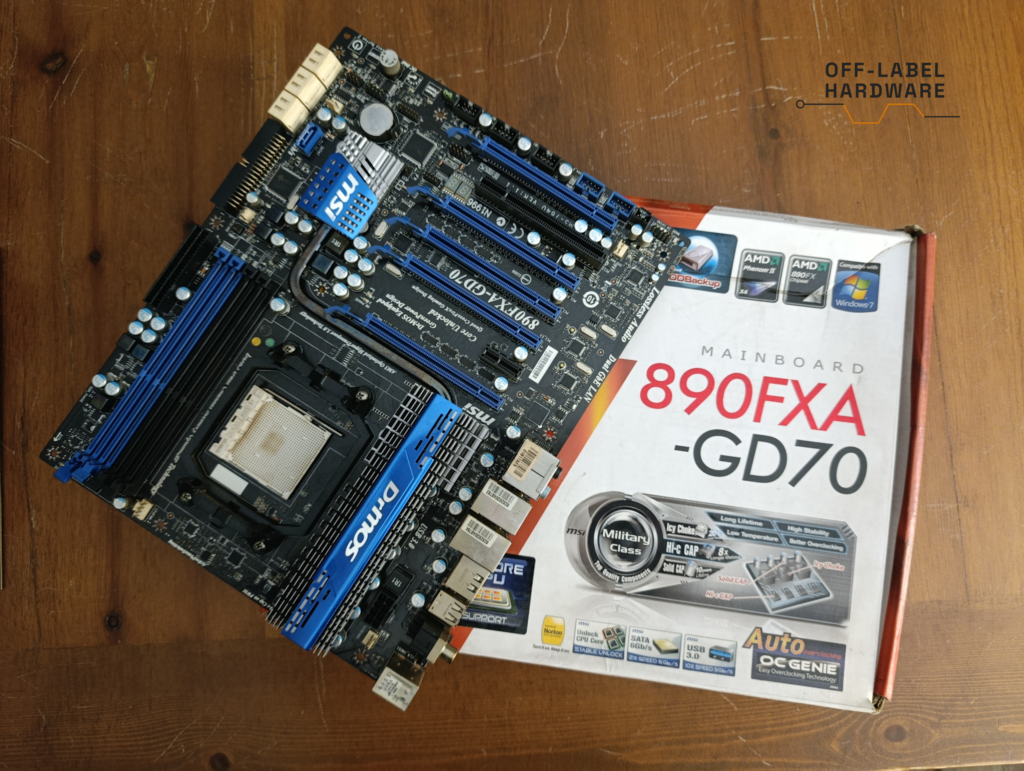
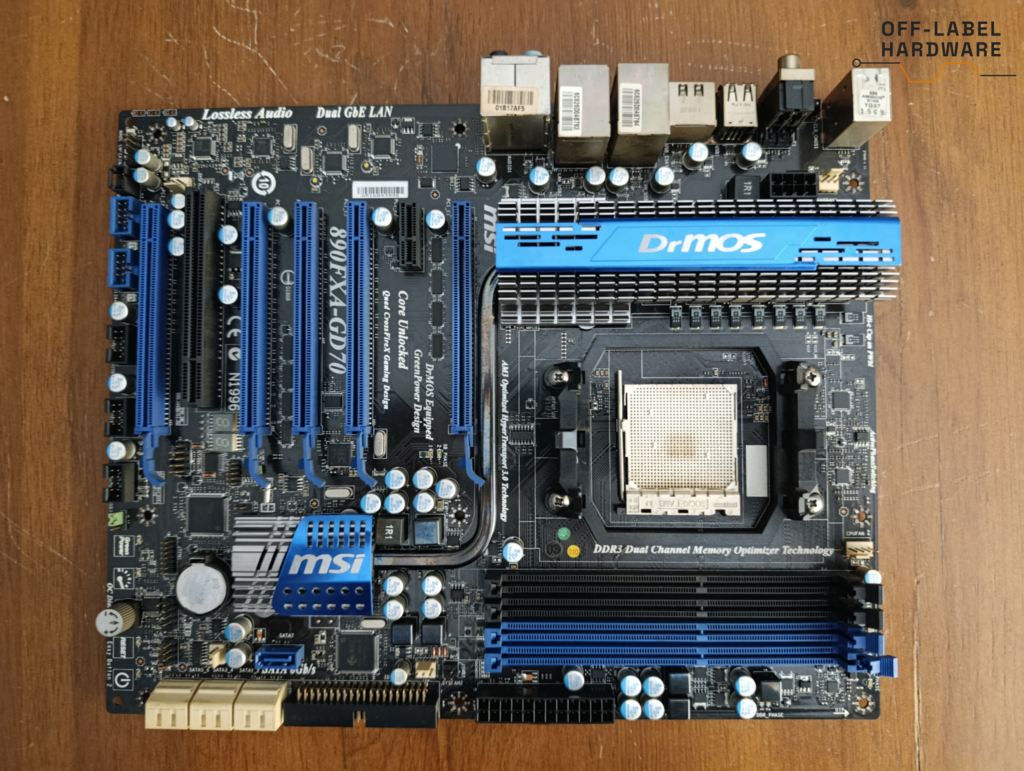
It was one of those motherboards that seemed almost excessive for the purpose. It has an unusually generous collection of expansion slots, along with features such as multiple Ethernet interfaces and digital audio connectivity.
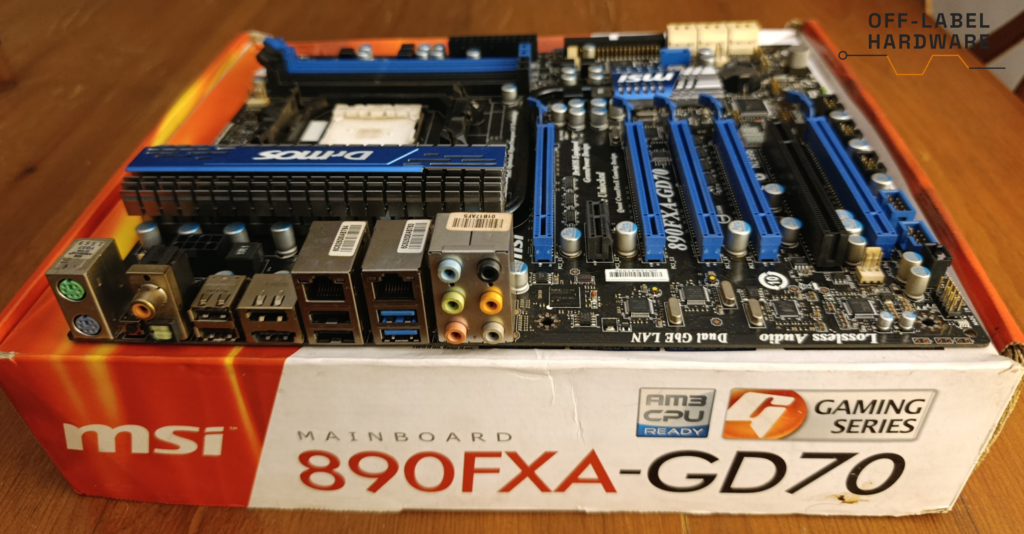
In a normal PC, several of those slots would probably remain empty.
For this project, that seemed like a waste.
So instead of stopping at the three cards required for the original idea, I started expanding the machine into something more like a video experimentation platform.
Then things got slightly out of hand
The three S-Video cards are the heart of the original experiment.
But there was no reason for the machine to be limited to them.
I added a Radeon HD 7770, giving the system a considerably more capable modern GPU for its era, including HDMI output and better video-processing capabilities.
I also added a Radeon HD 4850.
Part of the reasoning was practical: having another GPU with well-established Windows driver support could make experimentation easier.
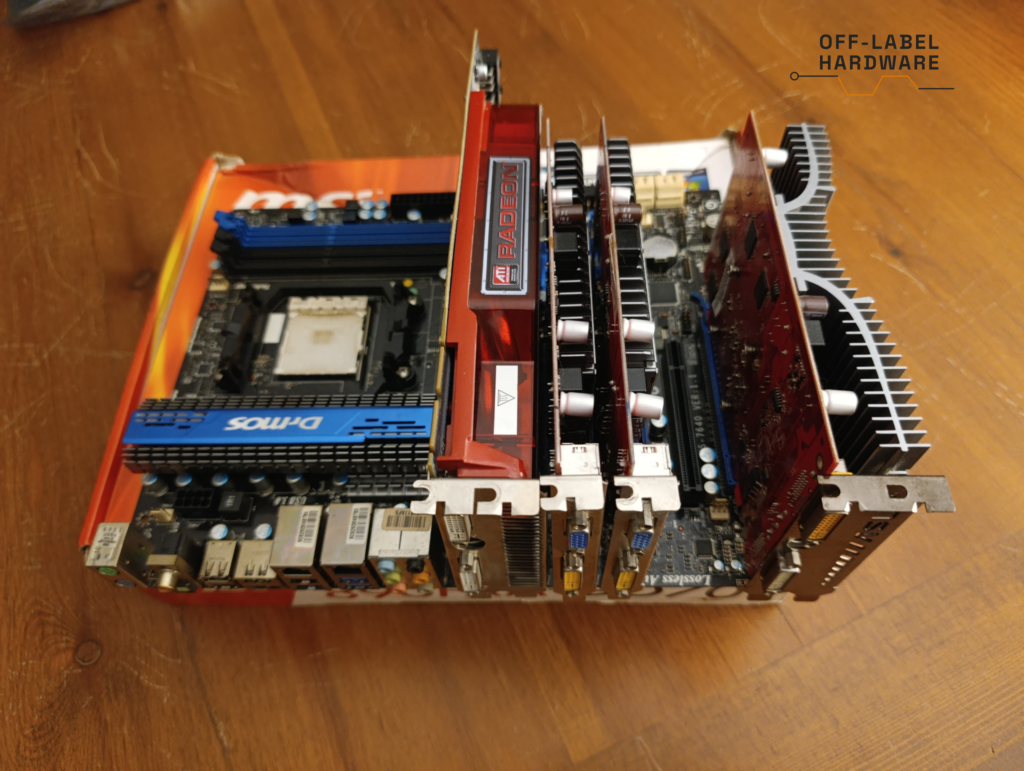
At this point, the machine was no longer simply a way of producing three S-Video outputs.
It was becoming a general-purpose experimental video workstation.
And then I found another piece of hardware.
Enter the FD322
I added a SoftLab-NSK FD322 professional video capture/processing card.
The FD322 isn’t required for the original three-channel S-Video concept. In fact, the project could exist without it.
But that’s precisely why I found it interesting.
The goal was no longer just to answer one question.
I wanted the machine to become a platform where different generations and types of video hardware could interact.
Consumer graphics cards.
Legacy analog video interfaces.
Professional video acquisition hardware.
Different outputs.
Different capture methods.
Different generations of drivers and software.
All in one machine.
The FD322 will get its own hardware entry later, because its capabilities deserve considerably more detail than I want to put into this introductory story.
What I don’t know yet
And this is where the experiment actually begins.
I don’t know yet whether three S-Video channels can be turned into a useful reconstructed video signal.
There are several problems to solve.
Synchronization is probably one of the biggest.
The three captured signals need to correspond to one another closely enough that their pieces can be reconstructed into a coherent frame.
Then there is resolution.
How much useful information can actually be extracted from each S-Video channel?
There is frame rate, latency, capture timing, scaling, signal quality and, of course, the reconstruction process itself.
And there is a more fundamental question:
Will the result actually look good enough to be useful?
I don’t know.
That’s the point.
Where the project stands
The hardware hasn’t been assembled yet.
For now, the cards are still separate pieces on the workbench.
That is intentional.
Rather than hiding the development process behind a finished build, I want to document the experiment as it happens—from the original idea, through the hardware selection and assembly, to the first signal and whatever happens afterward.
If it works, we’ll find out how far we can push it.
If it doesn’t, we’ll find out why.
Either way, we’ll learn something about what these old interfaces can still do.